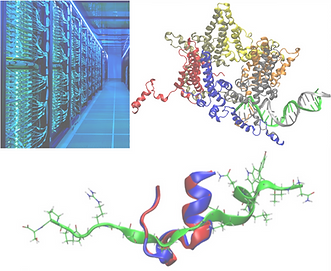
Course on Molecular Dynamics for Biomolecular Systems
In December, interested researchers from all locations of Center SynGen participated in a three-day course on Molecular Dynamics simulations organized by Dr. Mariana Kozlowska (DNA VirtMat Unit) in Karlsruhe. The course was aimed to equip participants with both theoretical understanding and practical skills to investigate the physical principles governing biomolecular structure, dynamics, and interactions.
Course Description:
This three-day introductory course (December 17 – December 19, 2025) provided a guided overview of molecular dynamics (MD) simulations for studying proteins, nucleic acids, and other biomolecules. Participants could learn the fundamental principles of MD, from atomistic to coarse-grained modeling, and gain practical experience in setting up, running, and analyzing simulations. The course was aimed to equip participants with both theoretical understanding and practical skills to investigate the physical principles governing biomolecular structure, dynamics, and interactions.
Key topics included:
• Foundations of MD simulations: force fields, integration algorithms, and system preparation for proteins, nucleic acids, and multi-component systems.
• Coarse-grained and hybrid approaches: mapping strategies, MARTINI, SIRAH, structure-based models, etc. for large-scale biomolecular phenomena.
• Structure prediction and refinement: AlphaFold and integrating predicted models into simulation workflows.
• Biophysical insights from simulation: connecting computational data to experimental observables such as NMR, cryo-EM, CD, FTIR and others.
The course combined lectures with guided practical sessions using state-of-the-art MD software packages (e.g., GROMACS). Participants could learn how to prepare and run different types of simulations using standard software packages and to analyze the obtained results to address current questions in structural biology, molecular biophysics, and chromatin organization.
Target Audience:
Graduate students and postdoctoral researchers, who wish to get familiar with computational approaches in structural biology, understanding of MD methods and their applications to complex biomolecular systems.